After great interest in education on the application of artificial intelligence in business, we continue with a new practical education focused on concrete steps of the implementation of AI in organizations.
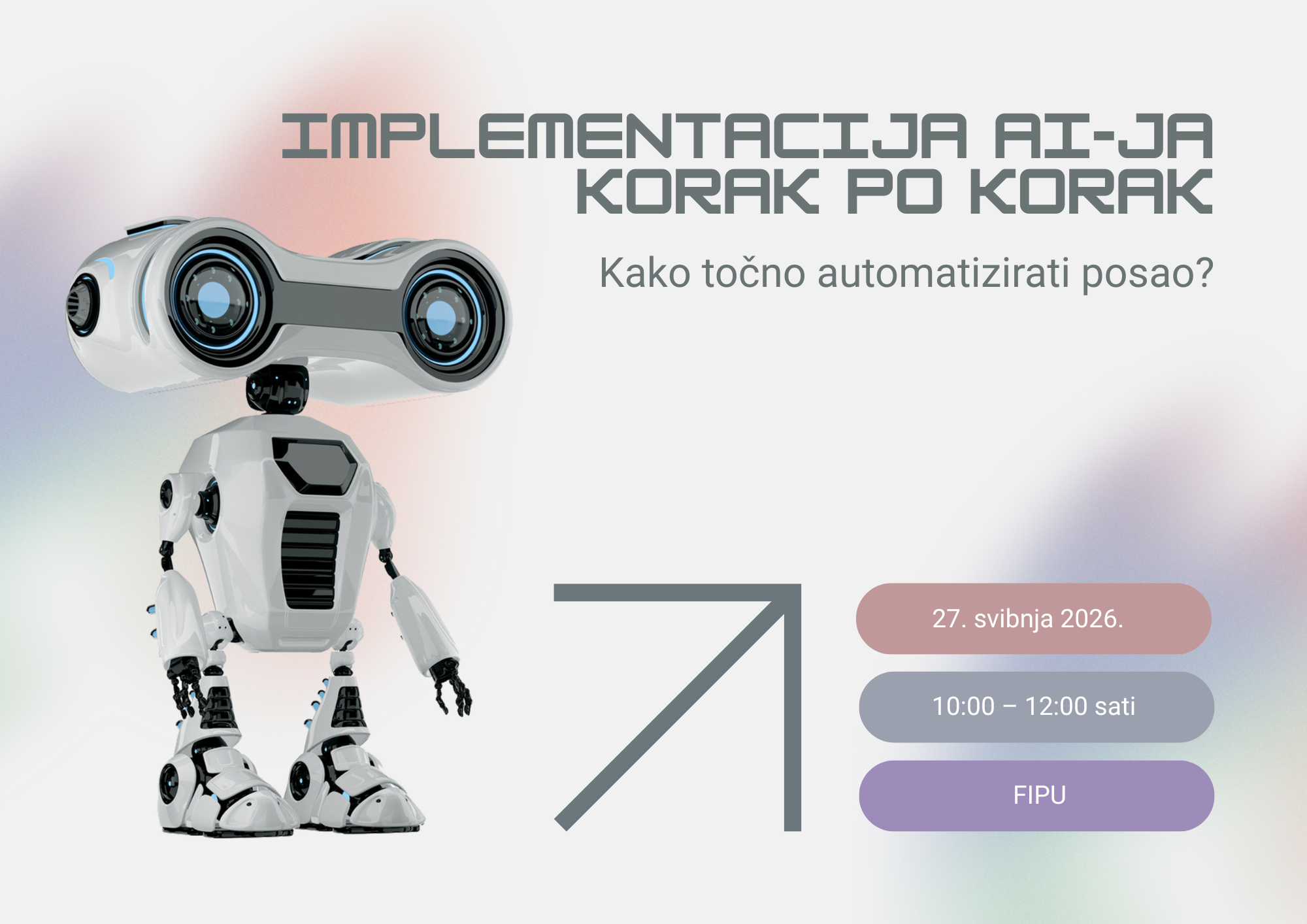
Education ‘Step-by-step implementation of AI: How exactly to automate a business” focuses on the question that many companies and organisations face today – how to move from a phase of interest and experimentation to a real application of AI in everyday business processes.
Through practical examples, experiences from real business systems and an overview of tools used today in sales, customer support, marketing and operations, participants will have the opportunity to get a more concrete insight into how to integrate AI in a meaningful, sustainable and operationally applicable way.
What will you learn?
- How to start with AI: Initiating AI transformation through concrete and proven business examples (use-cases).
- Development of AI culture (adoption): How to successfully introduce AI among employees and integrate it into the daily work of teams.
- AI in real processes: How AI is now practically used in key departments – sales, customer support, marketing and operations (ops).
- Tools and best practices: Overview of key tools, basic principles and best practices for working with AI.
- Application in small and medium-sized companies: How to easily replicate and apply all these practices and advanced concepts in smaller business systems.
- Evolution of automation: The path from using simple AI assistants to the first level of advanced automation and standalone AI agents.
Who is the education for?
The training is intended for:
- crafts
- small and medium-sized enterprises
- Medium-sized companies
- representatives of the public sector
Who runs the education?
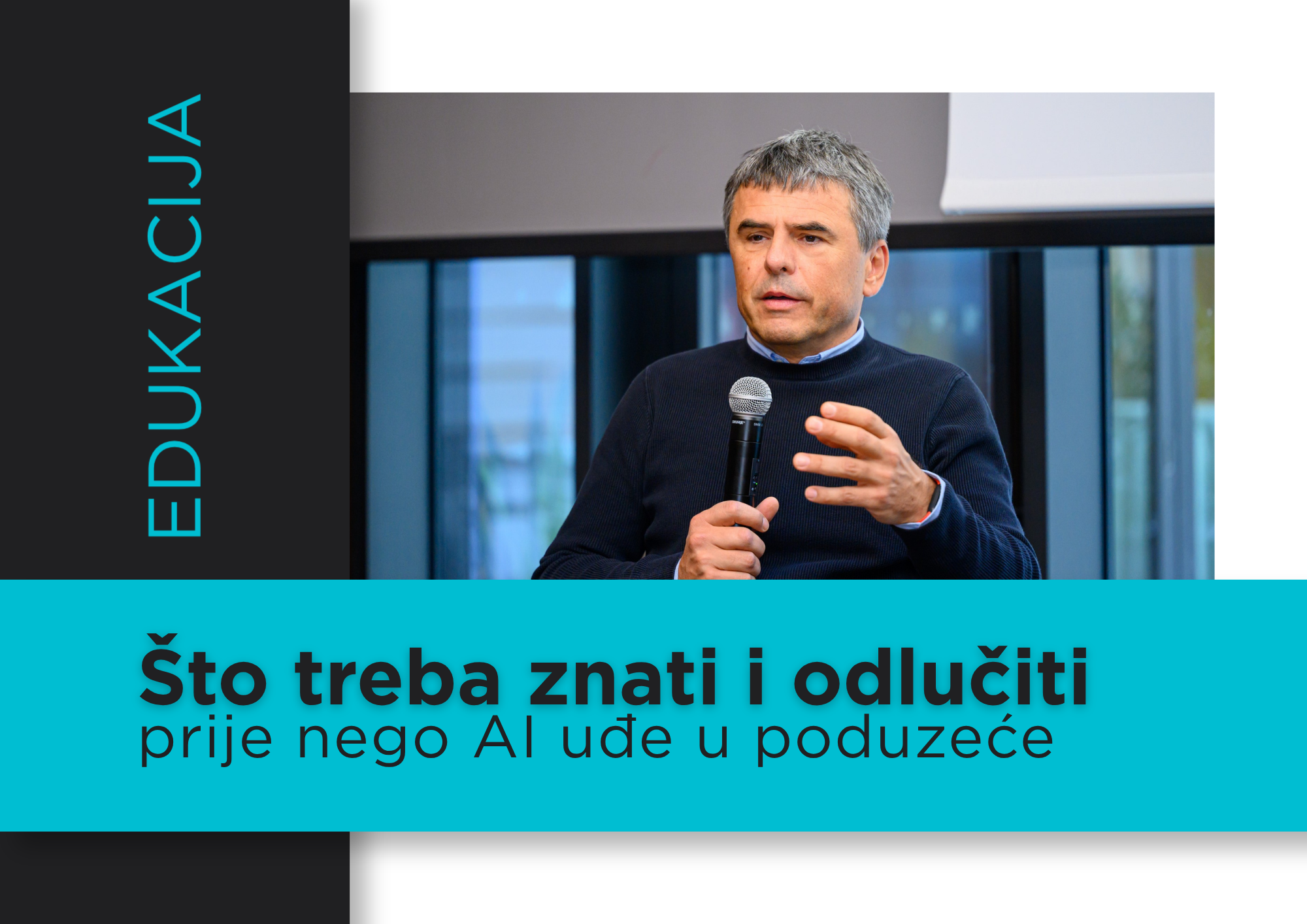
Water education Krešo Žmak and Jelena Nikolić Ražem.
Krešo Žmak is the Chief Innovation Officer at Infobip, one of the world's leading communication platforms, with many years of experience in shaping innovation strategies and stimulating the company's exponential growth. Krešo is focused on aligning technological development with business priorities, leading initiatives that ensure long-term competitiveness and business transformation on a global scale. He began his professional career as a development engineer at Siemens and spent most of his career in the telecommunications sector, advancing from engineering positions to IT and Business Intelligence (BI) Directors at Optima Telekom. His expertise combines a deep technical foundation, acquired at the Faculty of Electrical Engineering and Computing (FER) in Zagreb, with extensive experience in managing complex systems. This provides students with a unique insight into how to strategically lead innovations and successfully implement changes within large and dynamic business environments.
Jelena Nikolić Ražem She is the coordinator of the development activities of the EDIH ADRIA project, a key initiative for the digital transformation of the economy. Its focus is on operational management of processes that enable companies to access the latest technological solutions, with a particular focus on integrating AI into real business systems. Acting as a bridge between innovation and its concrete application, Jelena provides organizations with the resources needed for a digital breakthrough.
When and where?
Date: 27 May 2026
Time: 10:00-12:00
Place: Juraj Dobrila University of Pula, Faculty of Informatics - Room 107
Participation in the workshop is free.
Applications are received via these links by 23:59 on Wednesday 25 May 2026.