


Challenges
Primorje-Gorski Kotar County faces challenges in optimising public transport, especially in rural areas such as Gorski Kotar. The population of the area has limited possibilities to use public transport due to rare routes, uncoordinated schedules and the lack of integrated travel planning systems. In addition, there was no detailed database on transport supply and demand, which made it difficult to analyse the efficiency of the current system and plan improvements.
Solutions
Through the program Test Before Invest and with the support of EDIH Adria, Primorje-Gorski Kotar County has tested the possibilities of digital transformation of public transport through advanced analysis of traffic data and simulation of various traffic scenarios. The testing covered several key steps:
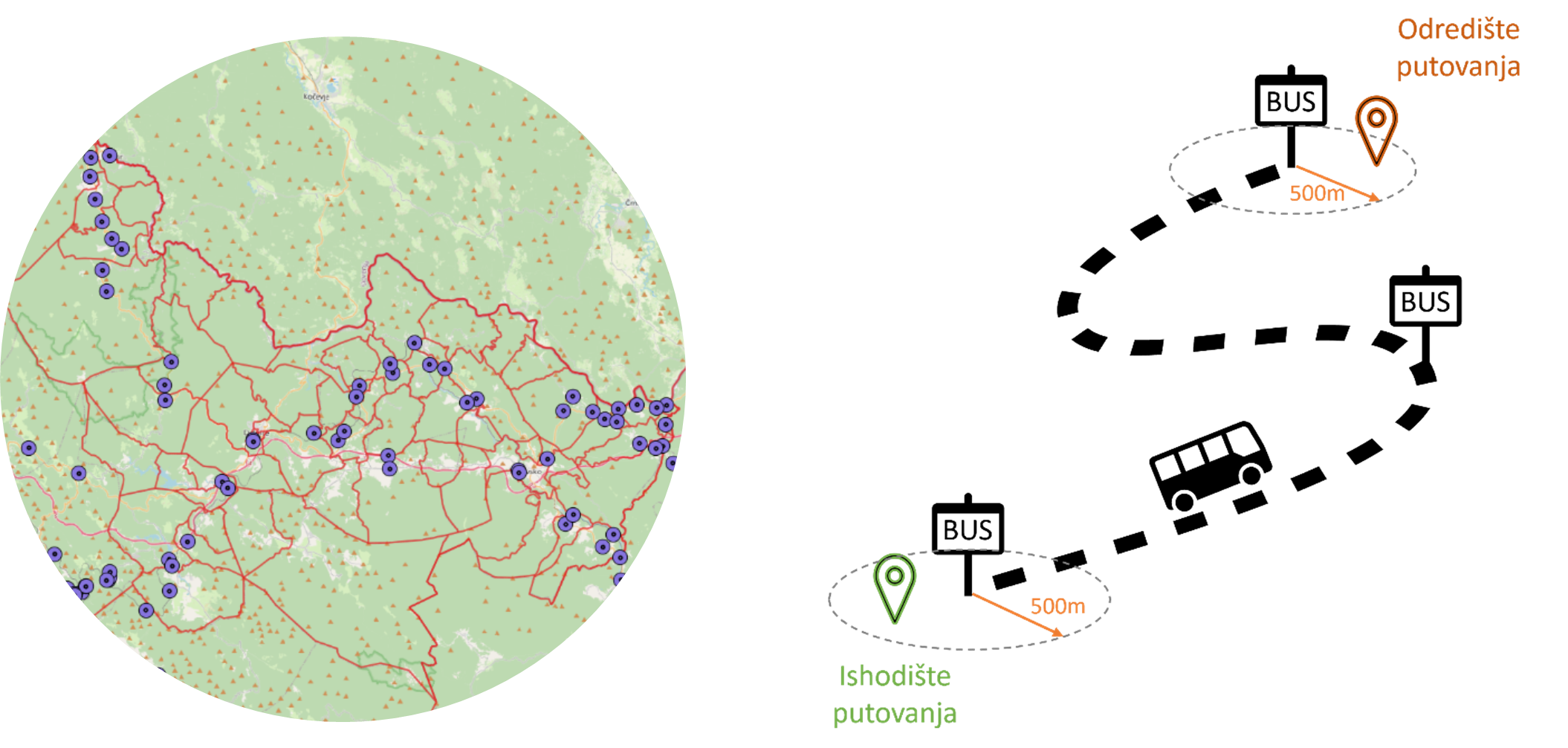
- Analysis of traffic demand using data from the mobile network to identify population movement patterns
- Creating a GTFS database (General Transit Feed Specification) that enables standardised modelling of public transport
- Development of a digital transport network model and testing of different transport scenarios
- Simulation of public transport performance, including travel time, route coverage and transfer options
- Proposing improvements through the optimisation of existing routes and the potential introduction of an on-demand transport system (Demand Responsive Transport - DRT)

Results and Benefits
Testing has shown that the digitalisation of the public transport system would bring significant benefits:
- Increasing transport availability by optimising routes and driving schedules according to the real needs of the population
- Faster data analysis using advanced digital tools, which would enable more efficient planning of transport solutions
- Greater system flexibility through the possibility of introducing adaptive solutions such as NRA
- Reducing operator costs through route optimisation and reducing unused capacity
- Better user experience thanks to more accurate and up-to-date timetable data and transfer options

Lessons learned
The testing identified key challenges and opportunities to improve the system:
- Validation and extension of the GTFS database – the current database is not yet fully compliant with carriers, so further work is needed on its completeness and accuracy
- Connecting all stakeholders – cooperation between all transport operators, local authorities and relevant institutions is essential for successful digitalisation
- Active demand monitoring – the introduction of passenger counting systems and regular analysis of transport usage data are recommended
- Digitalisation of the working timetable in real time – a dynamic GTFS database would allow citizens to access information on actual arrivals and departures of vehicles

Measurable data
The analysis of the test model yielded several key results:
- The GTFS database now includes more than 90% route in PGC, but further coordination with operators is needed
- The analysis of mobile data detected more than 20,000 daily trips within Gorski Kotar, which allows more precise route planning
- It is estimated that optimising driving schedules could reduce waiting time for transport by 30-50%
- The simulation showed that the introduction of the NRA system could cover up to 40% more users than the current system
Conclusion
Testing of digital solutions for public transport in Primorje-Gorski Kotar County has shown that modern analytical tools can significantly improve the planning and optimization of the transport system. Using the GTFS database and digital models, it is possible to accurately analyse transport supply and demand, which enables better decision-making and the introduction of innovative solutions such as transport on demand.
The next steps of development if the user decides to do so include further improvement of the GTFS database, implementation of test projects for the NRA system and the development of a digital platform that would allow passengers to access public transport information in real time.




 English
  Croatian
  Italian