


Challenges
The City of Opatija and the Municipality of Matulji, located in the heart of Kvarner, share specific traffic challenges arising from strong seasonal tourist traffic and complex local infrastructure. During the summer months, traffic jams become everyday, and the lack of reliable data makes it difficult to plan long-term infrastructure solutions and make quality decisions.
Traditional traffic monitoring methods – such as manual vehicle counting or occasional traffic studies – are not sufficient to understand the actual traffic dynamics. The need for digital tools that enable comprehensive and timely analysis of transport has become clear, especially in the context of sustainable development planning, adaptation to seasonal and climate challenges.
Solutions
Within the EDIH Adria service Test Before Invest (TBI), the City of Opatija and the Municipality of Matulji have joined the testing of advanced digital solutions for the collection, processing and analysis of traffic data. The aim was to examine how modern technologies – based on the AI and IoT approaches – can improve spatial planning, transport policy and day-to-day operational management.
During the testing, several methods and technologies were applied:
To begin with, anonymised data from the operator’s mobile telecommunications network was used to provide insight into mobility patterns – how many people enter, exit, travel through or within the observed areas. In addition, temporary traffic counters were installed on key roads, which gave concrete figures on traffic intensity, which served to calibrate the traffic model.
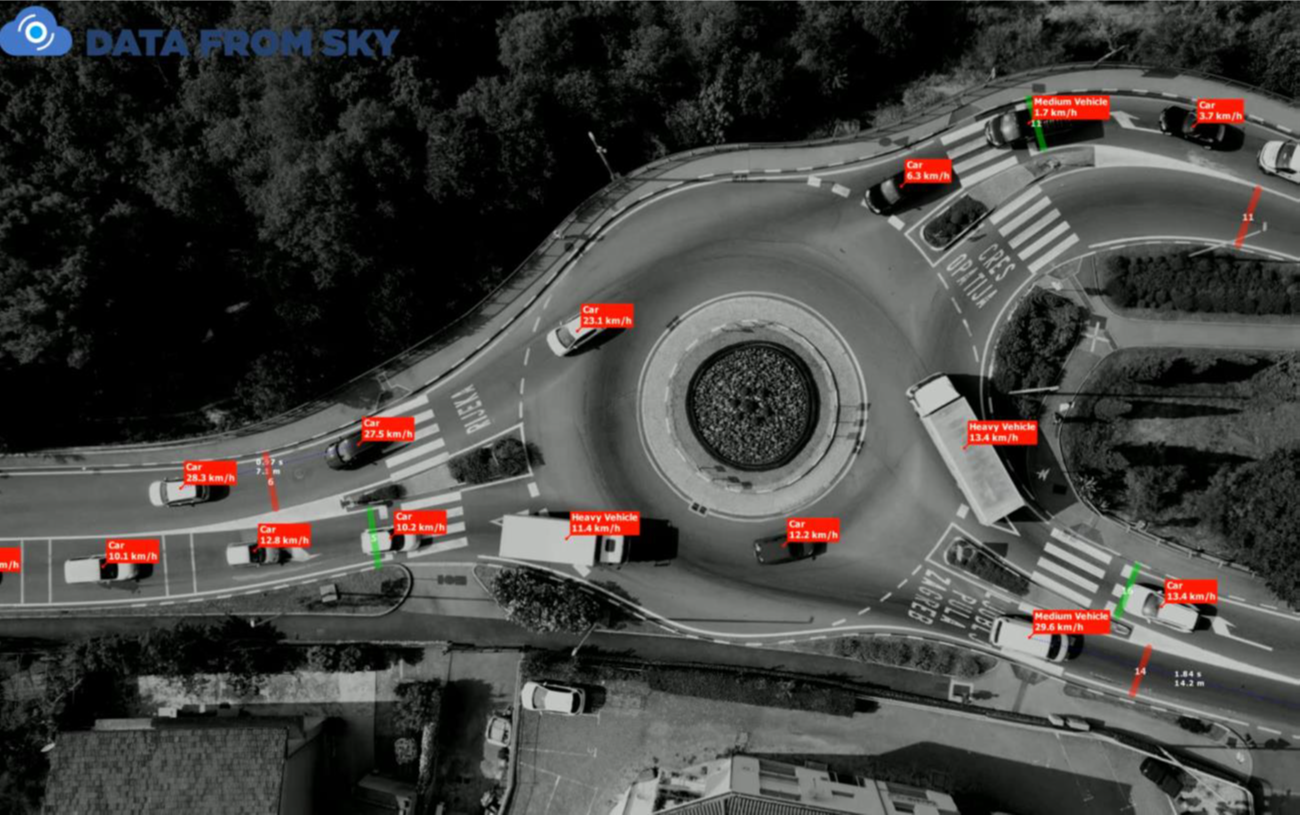
In addition, artificial intelligence was used to analyse video footage collected through drones and existing surveillance cameras. These AI analyses enabled the collection of metrics such as vehicle speed, traffic density, and classification of vehicles by categories (passenger cars, buses, pedestrians, etc.).
Based on the collected data, a digital transport network model was developed, which enabled detailed simulations of traffic flows. The model contained hundreds of nodes and links, and the simulations involved different scenarios – for example, road closures, the introduction of new traffic rules or the construction of additional garages. In addition to traffic aspects, the environmental impact of various measures (e.g. pedestrian zones, traffic penalization) was analyzed in order to emphasize the connection between traffic and the environment.
Results and Benefits
Although the testing did not refer to the implementation of the system in the production environment, but only to the functional prototype, the results clearly showed the great potential of digital technologies in improving traffic management.
The collected data and the developed models enabled a deeper understanding of the real traffic flows in Matulji and Opatija. For the first time, decision makers were able to see how traffic behaves during the day and week, which plugs are the most critical, and how certain infrastructure interventions would affect the daily lives of citizens and tourists.
Simulations have shown that by smart traffic flow management, digitalisation of intersections and better use of parking infrastructure, local units can achieve reduced congestion, lower CO2 emissions and greater safety for all road users. The project further confirmed the importance of a regional approach – as transport knows no administrative boundaries and cooperation between multiple LGUs yields better and more cost-effective results.
Lessons learned
The project has brought a number of important insights that can shape future development strategies:
First, the high value of data from mobile telecommunications networks and AI video analysis has been confirmed – as they can provide a precise and up-to-date picture of the real state of the road, at a lower cost than conventional data collection and analysis methods.
Second, the best results have been shown to come from a combination of multiple data sources – meters, cameras, mobile data and field observations. When all these data are integrated into a single digital model, there is room for much more informed and responsible decisions.
Third, the project showed that transport analytics is no longer reserved for large cities – with the support of digital tools, smaller communities such as Opatija and Matulji can plan traffic based on real data, not just intuition.
Measurable data
As part of the project, 14 counters were installed at 7 locations in Matulji, and 16 counters at 8 locations in Opatija. AI analysis of video material was conducted at key points (e.g. Kuk, intersection at Hotel Kvarner), which resulted in quantitative metrics for simulation calibration.
The digital transport model covered more than 450 links and 200 nodes. The model generated 24 time-scheduled OD matrices (Start-Destination Matrices), allowing dynamic traffic modelling for every hour of the day.
The estimated value of a complete traffic management system (including software, hardware and services) exceeds EUR 500,000, but in a regional context significant savings can be made through joint procurement and use.
Conclusion
The project, jointly implemented by the City of Opatija and the Municipality of Matulji in cooperation with the EDIH Adria team, showed how digital technologies can concretely improve transport policy and day-to-day mobility management. Although it was testing rather than implementation, the project produced tangible results – concrete data, validated models and clear recommendations that can serve as a basis for future investments.
The following logical steps include the development of an action plan for the digitalisation of transport, the preparation of project documentation for applications to funds and the continuation of cooperation between several local self-government units, with the aim of creating a smart transport system for the entire region of Liburnia.




 English
  Croatian
  Italian